The Exquisite Corpse:
a Gateway Game in Art and Education
This two-part, interactive
exhibit illustrates potential applications and implications of open-ended games
for education. Fostering flexible thinking and seeing things from a fresh perspective,
such games and playful explorations are relevant across disciplines.
Part I- The Game
André Breton and other
Surrealists believed that playing games “in the most paradoxical manner possible”
gave them “an infallible way of holding the critical intellect in abeyance,
and of fully liberating the mind's metaphorical activity”[2]. In other words,
chance and play invigorate creative cognition and expand imaginative possibilities.
A favorite game was The Exquisite Corpse, which creates a collective
verbal or graphic composition in sequence. Typically, each player writes something
on a sheet of paper, folds it to conceal most of the writing, and passes it
to the next player for a further contribution. Seemingly a trivial parlor game,
its popularity among the Surrealists was indicative of a growing resistance
to the privileging of rationalism then—and largely still--- fashionable.
Each week during the GSNYC exhibition, visitors will collectively play/ create
a new Exquisite Corpse (materials for this purpose are part of the
exhibit). Directions:
Without unfolding the paper, begin writing at the end of the exposed phrase.
In 1-2 sentences, write anything you want to say about Art, Games and/or
Education. Take any direction you wish-- factual, poetic, questioning,
whimsical, philosophical or practical. When finished, fold the paper over what
you have written, leaving only the last few words visible for the next player.
When the show ends, all Exquisite Corpses generated by visitor-players
will be digitally and/or otherwise available for viewing, dissecting and discussing,
thereby continuing this collaborative discourse on art, games and education.
Part II- The Sound
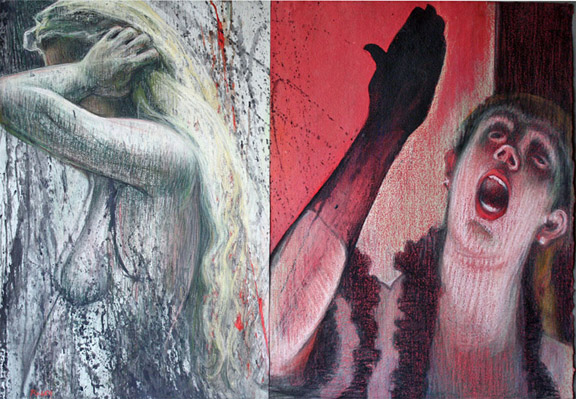
of One Hand (acrylic and pastel, 27 x 39”)
The title Sound
of One Hand comes from a famous koan, or teaching riddle. Written
by 18th century by Zen Master Hakuin, it served to demonstrate for his pupils
the inadequacies of logical reasoning, and to provoke enlightenment. As he explained,
the sound of a single hand “can by no means be heard with the ear. If conceptions
and discriminations are not mixed within it, and it is quite apart from seeing,
hearing, perceiving and knowing… then in the place where reason is exhausted
and words are ended,” insight is attained [2].
My process for this paintingincluded game-like techniques similar to playing
Exquisite Corpse; for example, leveraging uncertainty and randomness,
valuing process above product, and responding to the free interplay of juxtaposed
ideas and images-- what Bréton described as “liberating the mind's metaphorical
activity.” Appropriating random connections, we transform moments of life
into art, art into life, and chance into power.
Also on view: selected artifacts of the preliminary play-process in developing the concept for this painting.
Artist Statement
Art irritates expectation. Disrupts rational predictability. Arouses emotion; perturbs; provokes; challenges the fixed and definable. Intended to undermine ‘certainty,’ to suggest the elusive territory between what is known and unknowable, my mixed-media compositions materialize among accidental shapes and randomly juxtaposed images. They are less a statement that things are not what they seem than a simultaneous layering of things are/ are not/ and could be. Art shares with games like Exquisite Corpse the role of agent-provocateur, spurring ‘players’ to intellectually and imaginatively break laws for the sake of exploring new levels of signification. By disrupting habitual associations, reframing and rearranging the familiar through art or play, the world is momentarily de-familiarized and our blunted perceptions of it can be re-stimulated. Possibilities for creative engagement are expanded as we follow our curiosity through chance adventures of the mind.
Bio
Diane Rosen is a writer, educator, and artist. She has an MA in English Education from teachers College, Columbia University, and was the recipient of a French Government Fellowship in Painting. Her research interests center on curiosity and the creative process across disciplines: following the random turn, fostering unexpected journeys and fresh perspectives. Her book Bringing Inquiry In: A Curriculum Guide was published in 2010 by SPI (Student Press Initiative), Teachers College Columbia University. Currently, she is working on 'The Curiosity Habit,' a chapter for Perspectives on Creativity Volume II, forthcomingfrom Cambridge Scholars Publishing. http://www.rosenart.net